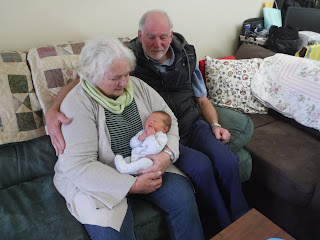
Friday, August 19, 2022

My friend Teresa

My friend Teresa has passed from this life to the next.  

"As for mortals, their days are like grass.
They flourish like the flower of the field;
for the wind passes over it, and it is gone,
and its place knows it no more.

But the steadfast love of the Lord
is from everlasting to everlasting
on those who fear him,
and his righteousness to children's children."  [Psalm 103:15-17]


My thoughts today have been mixed: the sadness that comes with the loss of a friend, and the gladness that she is now beyond suffering, and safe in the arms of her Lord Jesus.  

I have opened the ancient, somewhat tattered copy of The Pilgrim's Progress, an allegory written by John Bunyan in the 1600s, and gone to the last chapter, where Christiana and other pilgrims cross over the Jordan River, and into the promised land.  Here are some brief excerpts:


    When Christiana saw that her time was come, and that she was the first of this company to go over, she called for Mr Great-heart her guide, and told him how matters were.  So he told her he was heartily glad of the news, and could have been glad had the post come for him.  Then she bid that he should give advice on how things should be prepared for her journey.  So he told her, saying, thus and thus it must be; and we that survive will accompany you to the river side.
    Then she called for her children and gave them her blessing, and told them, that she yet read with comfort the mark that was set on their foreheads, and was glad to see them with her there, and that they had kept their garments so white.
...

[then she called for and spoke to Mr Valiant-for-truth, Mr Stand-fast, old Mr Honest, Mr Ready-to-halt, Mr Despondency and his daughter Much-afraid, Mr Feeble-mind ...]


    Now the day drew on, that Christiana must be gone.  So the road  was full of people to see her take her journey.  But, behold, all the banks beyond the river were full of horses and chariots, which were come down from above to accompany her to the city gate.  So she came forth, entered the river, with a beckon of farewell to those that followed her to the river side.  The last words that she was heard to say here, were, I come, Lord, to be with thee, and bless thee.
    

{page 240-241} 


Saturday, July 30, 2022

Loved Ones

I have recently returned home after visiting loved ones in 'sunny Queensland'.  This pic was taken in Brisbane.  Four of my five sisters, Jane, Chris, Barb and Anna, were present, and our brother Frank.  Marion was not able to make the trip this time.

As I move on in the ranks of senior members in the family, 'loved ones' have become more special, more precious.  I don't want to pretend that the love we share is without failings.  It's not.  I would say rather that it's the awareness of each other's unique personality, remembering our past, and not having to explain why, that enables a strong bond between loved ones.


I am not going to wander too far down memory lane, but today's second pic (taken in 1959) has the 'seven little Australians', as we were sometimes referred to, playing in the Pine River, near our home at Bald Hills.

In my visit it wasn't just the loved ones who made the time memorable.  We drove from Brisbane, West to Roma.  Places brought memories of crowded car trips - all of us like sardines in a can, no seatbelts, one sitting forward, the next back, and the ones most likely to get car sick having the window seats.  I think I learnt how to zone out, into my own quiet world,  watching what I could see of the distant horizon, the big sky, the constantly changing landscape. 


As I ponder the bond that has been maintained with my loved ones over the decades, I wonder how the next generation, and the next, will do.   I wonder if new generations of parents will value attachment - that physiological phenomenon that forms strong bonds between a newborn baby and the mother in the first instance, then the father, other family members, and the child's community.  Mothers today are expected to return to work quickly after childbirth.  In accepting this plan, they have to override their natural, hormonally guided instincts to nurture their young. It is worth remembering that the Judeo-Christian Scripture tells us that when God the creator saw everything that he had made, "indeed, it was very good".  My experience in midwifery, and in mothering, has convinced me that it IS very good. 


Thursday, June 30, 2022

CAN A WOMAN FORGET HER NURSING CHILD?


Today I am pondering this question, taken straight from the Christian Scripture, Isaiah 49:15.   

Can a woman forget her nursing child,
or show no compassion for the child of her womb?
Even these may forget,
Yet I will not forget you.


I remember a lovely hymn we used to sing, repeating the verse:

Can a woman's tender care
cease toward the child she bare?
Yes, she may forgetful be
Yet will I remember thee.

Read the whole chapter, Isaiah 49.


The image of the woman and her child is repeated frequently in Scripture.   References to every-day life events make sense to the reader, and what could be more real than examples from the most intimate moments in a family's life?

I have calmed and quieted my soul,
Like a weaned child with its mother;
My soul is like the weaned child that is with me. (Psalm 131:2)


The answer to the question heading this post makes sense to me.  Of all the unlikely outcomes, the prophet concedes, "Even these may forget".  It's as though it's so unlikely it's almost impossible.  Everyone knows the devotion of a mother to her sucking (or nursing) child.  

The world as we know it has, to a great extent, forgotten this primal knowledge of the relationship of a mother with her child.   Weaning of a child in Isaiah's time, or the time of the Psalms, or the rest of Holy Scripture, may have been when the child was around five.  Years, that is!  Not five days or five months, as is so common in our advanced social structure. 

The Creator God provided all that was good for the race that was made 'in the image of God'.  The human race, male and female, equally bearing the image of God.  God looked at what He had created and saw that it was very good.  Science has confirmed this.  The wonder of bonding or attachment of the newborn with the mother, moderated physiologically by wonderful hormones such as oxytocin, and endorphins,  enables normal processes to continue today as they did in pre-modern societies where an infant would not have survived without her mother's constant attention. 

Women of my generation did not understand much about the physiology of birth and nurture of the newborn when our babies were born.  As a student of midwifery I had learnt a little about synthetic oxytocin and other substances that can be used to stimulate contraction of uterine muscles.  These substances, essential additions to a midwife's kit, have saved many lives.  But when I experienced  the spontaneous natural processes of child-bearing I began to glimpse the truth of the statement "it was very good".  


Can a woman forget her nursing child?

Not likely.  Not when the slightest mention - sound or sight or thought - can bring on a 'let down'.  Not when a few hours after the previous feed her breasts are becoming tender and full.  Only the little one brings relief.

Yet, 'even these may forget'.  The prophet of old acknowledges this unlikely, but possible scenario.   

A mother who becomes exhausted, or depressed, or ... overwhelmed.  A mother who is ill.  In her mind she does not forget the child, but her body's hormonal response to prolonged separation is a forgetting.  In fact, her body begins making preparation for another pregnancy. 


 [Picture: Maria Lactans 17th Century. Antwerp]


Tuesday, June 14, 2022

Kindness

The logs on the ground in our front yard were huge.  Way too big for Noel to lift or move with a crow bar.  So we mowed around them.  The rest of the wood from that old tree had been cut up, split, and burnt to heat our home. 


Then, one cold afternoon, the young chap who had recently moved in next door arrived, driving a heavy duty earth moving machine, and moved those huge logs one by one to the wood pile.  He told us he will be back with another piece of machinery to help split the wood.


Kindness. 

Thankyou, dear neighbour.

Monday, June 06, 2022

Story Time

Today I am wrapped in layers of warm clothing, as I seek to counter the cold bleak early winter's day.  The fire in the wood burning stove, burning heavy pieces of river red gum, is faithfully spreading warmth.  Occasionally the  sun breaks through the clouds, adding bright light and a little additional warmth through the large North-facing windows.  

One of the advantages, from our perspective at least, that the 'covid-19' pandemic has brought, is that we stay at home unless we have somewhere important to go.  This self-imposed restriction has led to a new, or renewed, enjoyment of reading.  Out loud, that is.  Noel usually reads, and I listen.  My eyes have not stood the test of time as well as his have, so I enjoy listening.   Most mornings, after breakfast and shower, we read a couple of Bible passages, a devotional message, and commit our day, and all that is precious to us, to our loving Father.   Most afternoons, after lunch, we have 'story time'.

I haven't kept a tally of the books we have read in story time.  Some have been recently published; some quite old.  We have old books that we inherited mainly from Noel's father, who frequented second-hand book shops and who over-flowed his book shelves. 


Our current old book is Charles Dickens' novel, David Copperfield, with illustrations by W.H.C. Groome, and published by Collins Clear Type Press London & Glasgow (no date given), and has 876 pages of rather small print.  I had forgotten how wordy Charles Dickens is, or perhaps how very brief is the literature I have become used  to.  This copy is tattered, with a blotchy water damaged front cover that has been repaired to keep the cover attached. 


There is little, on the surface at least, in David Copperfield that I have had any connection to, in all my life.  Yet I find the story telling, the use of the English language, excellent.  It draws me into the story.  It makes me look forward to the next chapter, and the next.  I know I will feel sad when the story ends.  


I don't know how to end this post.  I have no message to share.  Rather, I have chosen to share a brief glimpse of our lives as we are today.

Monday, May 23, 2022

When a midwife records the sex of a newborn baby

In recent years I have heard statements about a newborn's sex being 'assigned'.  

What does this mean?


In all my years as a midwife, and all the thousands of babies that I handled and observed, I did not ever see a baby who needed to have an assignment as girl or boy.  It's almost always obvious.  

When our son Paul was two and a half, and we were awaiting the birth of our fourth child, Paul declared (with the purity of thought of a 2-year-old) "I just want my bruvver to be a boy!"  

Back in the days when a midwife filled out forms to record the details of each baby's birth, The baby's sex was one of those details.  The options in 2010, on the attached data form, were 

Sex:     Male □  Female □      Indeterminate □ 

The initial record of a newborn's sex is just one of the many items that the midwife records, along with the mother's reproductive history, details of this pregnancy, the labour, birth and postnatal events, and the baby's condition.  These details are collated into annual reports of perinatal data, and deidentified data are published for each year.

As I have already indicated, the sex of the baby is usually undisputed.  However, if there is something unusual about the baby's external genitalia, the record may read 'Indeterminate'.  This baby may, after further investigation and discussion, have had an 'assignment' of one gender or the other.

You may wonder what's the point of this discussion.

In recent years I have become increasingly aware of trends such as gender fluidity, as if gender is a choice that a person makes, and in this context, sex assignment.  I decided to put on record, in May 2022, the fact that the sex of a newborn, and therefore the gender, is recorded rather than assigned.

I do not have the mental agility these days to argue against the crazy things about gender that are being taught to children today.  Children whose minds and behaviours are being molded by people they trust.  My prayer is that children will use their clear vision, their uncluttered minds, to say "my bruvver is a boy."  Or, as in the fairy tale, to call out "but the emperor has no clothes!"  


Sunday, May 15, 2022

How to Handle a Woman

You might recognise the title of this post as a song in the 1960 musical 'Camelot'.  In the 1960s, I doubt that many eyebrows would have been raised.  After all, in the '60s Australia a man's home was his castle.  If he 'handled' his wife in a rough or cruel way the police would not intervene.  In today's world police will respond to such a call, and provide what support they can and 'handle' the offending man.

Today's world is very different from the 1960s.

Today, when I saw the words 'How to Handle a Woman' as the title of the sermon in our Church, I reacted strongly.  Not happy!

In the world of 2022, when politically correct leaders are not prepared to define a woman as female-adult-human, I find 'how to handle a woman' offensive.  The thought of being handled!  Even as the message explained the wonderful truth that "Jesus loves his bride in the same way we ought to love others", I could not see past the unequal status implied in this title.  

All my adult life I have known the truth of Biblical principles, that "There is no longer Jew nor Greek, there is no longer slave or free, there is no longer male or female, for all of you are one in Christ Jesus." (Galatians 3:28).  Just because it's clear doesn't mean it's followed.  Early Christians struggled with the racial issue (Jew/Greek); for centuries dominant cultures have given privileged position to one social-financial status over another (slave/free), and we Christians (some of us, at least) still have a problem with male and female.

People who read what I write will not be surprised that I am an admirer of all creation, especially the woman and infant.  When the work of creation was completed, God looked at what he had created and said it is good.  In midwifery I was frequently in awe of the mastery of systems in conception, pregnancy, birth and nurture of the child.  It IS good.

Good when systems are working to the design.

Good when not fiddled with, manipulated, interrupted.

Good when not feared.


Good, but not infallible.  Even the most healthy mother can be compromised.  Recognising that situation, and being able to take appropriate action is the essence of midwifery.


My husband Noel and I are in our 50th year of marriage.  We have both changed with time, and with the influences and experiences we have faced.  I am happy to record here that neither of us set out to 'handle' the other.  


Sunday, May 01, 2022

He restores my soul


Hello dear reader.  It's a chilly Autumn afternoon here at our home among the gum trees.  But I don't want to talk about the weather.  I have a warm knitted cape made from beautiful pure wool over my shoulders.  But I don't want to talk about knitting.  Not today, that is.

You may know the source of the heading I have used for this post,  'He restores my soul'.  It's a phrase in one of the most well known pieces of Christian scripture - the 23rd Psalm.

I would like to tell you today about how I have experienced the restoring of my soul. 


Firstly, I would like to record here a couple of points.

  1.  This site, 'villagemidwife' has allowed me to share my knowledge and passion for midwifery for a decade or more.  I loved writing, story-telling, commenting.  Then, quite suddenly, I realised I had to stop.  I was physically burnt out.  I was old.  I needed to go to bed, and stay in bed, each night - a midwife may not have that option. 
  2. I have continued to use the 'villagemidwife' site so that I remember the person I was.  I wrote, and spoke, with confidence.  It did not matter to me if anyone read my posts.  My hope was to record experiences and learnings, so that perhaps one day someone would experience for themself the wonder of childbearing and nurture as I had. 
  3. I have to acknowledge that I feel much less confident writing about life generally than I did when writing about mothers and babies.


The past couple of years have brought the covid 19 pandemic to our homes, schools, hospitals, ...  I have followed news reports and websites closely, learning the language of this virus, and the often confusing recommendations of the host of medical experts whose expertise is in infectious diseases, immunology, and epidemiology.  In the State of Victoria we had months of severe restrictions, and lockdowns.  

In this context of frequent change to the rules, I experienced an indefinable drag on my energy.  The aches and pains of an ageing body, the shoulder, the knees ...  I missed seeing my children and grand children.  The wonders of modern communication, with Zoom, and face to face telephone calls somehow did not satisfy me.  I need face to face.  I need touch.

The lack of energy was, as far as I can see, depression. 

Then these words became real.  "He (GOD) restores my soul."  He restores my soul, my whole person, from the emptyness, the drag, the loneliness, the sadness that has crept into the very essence of my being.

I have known the Twentithird Psalm for as long as I can recall.  My mother must have taught it to us.  We often sang it in Church.  But I had never before noticed this beautiful phrase, "He restores my soul."  Now it jumped into my consciousness.  Not a power switch - now you're fixed!  But an ongoing work of restoring and continuing to restore, as long as it's needed.  

And I dare say that ongoing work of restoring will be needed for some time - without limits.


Saturday, April 23, 2022

Holding onto old photographs


Photo:  Noel, me, and our baby Miriam, posing for a photo (using the timer) in our back yard in Haslett, Michigan (early 1974)

We were young and we were beautiful.   We had moved from Melbourne to Michigan, and Noel had a scholarship to undertake graduate degrees with the Dairy Science department of Michigan State University. 

The falling 'snow' in this image has appeared magically - and I don't know how to get rid of it.  I'm pretty sure that I would not have stood in falling snow with my baby so exposed.  I had seen snow once before going to USA.  I had done a tourist bus trip to Mount Kosciusko and the Snowy Mountains when I drove from  my home in Brisbane, to Melbourne, to study midwifery. 


Every photo has a story.  If I were to show this pic to our daughters they would guess the details.  Our sons may not.  I wonder if anyone will value this, and the many other pics, some of a lesser quality, when I am no longer able to tell our stories?

Monday, April 18, 2022

Return to blogging?

[pic: Autumn colours this week in Kyneton.  With my sister Barbara, who is visiting from Western Queensland.]


Hello dear reader.

A decade ago I was an active blogger, confidently recording and discussing my thoughts and experiences as a midwife.  Midwives, midwifery students, and others were reading the blog and occasionally commenting.  When I retired from practice I felt I needed to also retire from blogging.  I had no contemporary knowledge to share.  I had no stories to tell.  And besides that I was weary.  Burnt out.


Writing a blog is not much different from writing a diary.  There are few rules.  I am free to write about anything I choose. That's one side of the coin.  The other side is more complex.  I need to know that I have something worth saying.  I need to be ready to answer challenges that may arise.


If I am to re-start on the blogger's pathway, I think I need to find a subject that I am willing to explore and share.  I need to find new stories.  What does a woman in her 70s have to say in 2022?  Perhaps the real question is 'is there anything that I should not say in 2022?'  


People of my generation often have time on our hands.  As you see from the photo accompanying this post, Autumn is upon us,  and winter is not far off.  We have a log fire burning this afternoon, and it's raining outside.  More rain than we've seen for months!  Wonderful!

People of my generation can spend time reading and responding.  We can reflect on the decades of our own lives, and what we learnt from people of previous generations.

People of my generation may not care if their views on a matter are out of date, or against the popular view. 

People of my generation are becoming increasingly conscious of our own limitations.  We may get cataracts in our eyes and need replacement lenses.  We may need knee or hip or shoulder replacements; we may have too much cholesterol, or liver or kidney problems; we may be obese.   We may be active in all sorts of groups and clubs, or we may be overwhelmed by loneliness or sadness.


Our world has been struggling with the covid pandemic for the past two years.  During the days and weeks of self isolation I have worked on scanning and collating old photos and documents.   That gives me a starting point for my next blog entry.  

What is worth keeping?  

How can this be done?


Saturday, December 18, 2021

The year 2021


This time last year I commented on words such as 'unprecedented', as it applied to the COVID 19 pandemic which continues to seriously affect our world's physical and mental health, and the economy.  This year, the word that has surfaced many times in my mind is 'fatigue'.  During a long, cold winter, with restrictions on movements and activities, and unprecedented efforts by our governments to provide vaccination for all, fatigue has been evident in my little world, as well as the big world out there.  And recent changes to the 'rules' do not provide me with assurance or comfort.  We can only imagine what lies ahead.

By way of contrast, I have been encouraged by a phrase in a Christmas hymn, 'The thrill of hope, the weary world rejoices' (from O Holy Night).  I encourage you, dear reader, to ponder the hope we each have in our Saviour Jesus, the message of Christmas, and the hope that our weary world will truly rejoice.

This year, as with last, I do not have a photo of all our children and grand-children.  The group photo was taken earlier this year when we met up for lunch with Paul, Emily, and Poppy, Zachy, and Abigail, and Josh and Anna, Eve and Norah. 

Having spent a lot of time at home without visitors, I have enjoyed working on some of our family's history, gathering and scanning old photographs and putting together a book about my grand parents Tom and Jessie Davidson.  With the help of cousins, some of whom I have not seen since childhood, I have prepared a book and distributed it as a digital file so that family members can print out their own copies.  I hope the younger generations will hold onto and treasure the images and stories from previous generations.

Another project has been to help my sister Marion Andrews with desktop publishing of her story, 'All the way to Bamaga'.  This is the story of Jie Jie (Mandarin Chinese for 'big sister') and 'Little me' and our younger siblings and parents, and our time in far north Queensland.  

Enough of my doings.  Noel has kept himself busy with work  in our local church, Gisborne Pres, and as convenor of the Victorian committee of Australian Presbyterian World Missions.  He also takes the lion's share of caring for the livestock in our little piece of country - ponies, chooks, Bingo the dog, and a recent addition - a hive of bees.  We are thankful for the health and strength that we have. 

This year we are planning simple gatherings for festive meals on Christmas day and Boxing day.  We are very conscious of the threat of the current strains of the covid virus, without being fearful as we know that God works in all things for the good of those who love Him, who are called according to His purpose. (Rom 8:28)

We would like to take this opportunity to send loving greetings to you and your family.

Joy and Noel


reflecting on the year 2020


REFLECTING ON THE PAST YEAR

The year 2020 has brought unexpected and often undesired changes into our lives.  The word ‘unprecedented’ has taken on new meaning not just in our family, but in our world.  In response to the COVID 19 pandemic, we have experienced restrictions to freedoms that, previously, had been taken for granted.  Our freedom of movement was curtailed when ’stay at home’ orders appeared.  Our practice of weekly attendance at Church has been blocked for many months, and substituted with electronic broadcasts.  We have returned to Church, with masks and a sign-in ‘QR Code’ and other restrictions as reminders of the ongoing threat. Our freedom to visit our families in the greater Melbourne area was denied during the months of ’lockdown’, with a ’ring of steel’  that could not be traversed either way without a suitable permit.   Our children’s access to education has been disrupted, and replaced, with varying degrees of acceptability, by Zoom sessions and supervision of home learning by (mainly) mothers.   At the same time mothers and fathers have also been working from home. 

This year there is no ‘all-of-the-family’ photo.  We have not been together at the same time.  We are thankful for the small gatherings that we have been able to enjoy. 

We (Noel&Joy/Dad&Mum/Grandpa&Granny) continue to enjoy our ’lifestyle’, with chookies, ponies, and Bingo to look after; grass to mow; fruit trees and garden to water and tend.   We love the opportunities that we have to care for our precious grandchildren, and each day we pray that God will protect, guide, and strengthen each family. 

[picture:  our new grand daughter, Abigail.]


Friday, January 31, 2020

The size of families

My great-grandmother, Angelina, died in childbirth.  She left eleven children.  My grandfather, Frank, was just four years old.

My grandmother, Jane, also had a large family.  After her eighth child was born, her husband Frank moved out of the marital bed and slept on the verandah. 

My mother, Ella, gave birth to seven children.  She then had a hysterectomy and pelvic repair.

I ponder the realities of death, abstainence. sterilisation.  
 
My forebears were fertile.  From the time of marriage they expected to welcome a new baby, sometimes two, every couple of years.  Most mothers were busy with the work of feeding and caring for their families. 

My generation, born after the Second World War, had new contraceptive options.  Women were no longer expected to stay at home looking after children for the rest of our productive lives.  My husband Noel and I joyfully welcomed our four children, and decided that four was enough.  We did not question the fate of the potential babies that we carried in our bodies.  We sought to care for the four children we had, and to be satisfied with them, and with each other. 

I remember when I was pregnant saying, "I don't mind if it's a boy or a girl.  As long as it's healthy."  
What right did I have to demand or expect a healthy child?  How ignorant!


The size of families, and whether or not to have children at all, is a topic that should concern the present generation of potential parents.  We face a social environment in which many women are unwilling to submit to pregnancy, childbearing, and the nurture of the young; where both men and women protect their freedom and don't want to be tied down to a family, or women leave their run so late that they face infertility.  The failure of today's generation to be willing or able to become parents is no less a societal disease than infectious diseases that wiped out babies and children of previous generations prior to vaccines and a scientific understanding of infection.   


In reflecting on this topic, I was drawn to a well known Biblical passage, written at the very dawn of the Christian era.  The Apostle John wrote: "He came to that which was his own, but his own did not receive him.  Yet to all who received him, to those who believed in his name, he gave the right to become children of God; children born not of natural descent, nor of human decision, or a husband's will, but born of God."  (John 1: 11-13) 

The point that is clear in this statement is that John identified decision-making processes that were recognised as the norm.  In our day, we can add "a woman's choice".

unsound ultrasound

From time to time I have faced a challenging situation, in which the report from a prenatal ultrasound leaves the pregnant woman and her husband with more questions than answers.  Prior to the ultrasound scan, there was a tiny person inside her womb, growing, constantly taking nutrition from her blood, and causing the nausea and other physical effects that come with hormonal changes.

They looked forward to the scan.

... an opportunity to confirm life and wellness.

... their child; welcome and already loved.

Then a phone call.  "You need to make an appointment to talk to the doctor about the scan."

The science behind prenatal diagnosis is significant, and developing constantly.  Risk assessment, especially for Down (or Down's) Syndrome is fairly standard in today's maternity care.  This includes measurement of the translucency or thickness of the nuchal fold, and identification of soft markers.  Most women (or couples) undergoing ultrasound scans in early pregnancy have no idea that they may be expected to make the chilling decision to abort or not.

Ultrasound is not essential to maternity care.  If a pregnant woman knows she does not want ultrasound she can decline the test.  But most would say that they want to 'see' their baby.

Our world today does not acknowledge the Judeo-Christian principles about the sanctity of human life.  When I see  the familiar images from ultrasound screening I see a person who is created in God's image.  A person for whom the 'You shall not kill' principle of the Ten Commandments applies.

When unprepared women attend ultrasound screening they love to see the movements, especially before the time of quickening, around 17-20 weeks, when they can feel movements.  They love to see the tiny thumb going into their baby's mouth.  The heart beats rhythmically, and the rate is recorded. 

The technician makes other routine measurements, and notes them down.  She or he is looking for anomalies: the unusual or abnormal.  These matters then become reasons for further testing, and, frequently, reasons for terminating the pregnancy.

Ultrasound is a serious medical test.  It has been used for protecting the life of a baby who would otherwise have died.  It can be the beginning of an unpredictable and unplanned journey through new terrain.  For example:


  • The baby's heart had not formed properly.  He had an under-developed Right atrium.  He probably will not survive, and if he does, he will need open heart surgery.  The parents are advised to abort their baby at 22 weeks.
  • The measurement of the baby's head is small.  She will probably have microcephaly, and brain damage.  Subsequent ultrasound measurements lead to confusion about the baby's condition.

Many women today in our society are entering motherhood for the first time at an age when the risk of Down Syndrome is already increased, before they consider the results of ultrasound scans.  A woman is told that at 40 her risk of conceiving a baby with Down Syndrome is *high*, at 1:100.  Then she is told that there is a *small* 1% risk of spontaneously aborting following amniocentesis.  1% is also 1:100.

Our world is subject to disorder, disease, and corruption - even down to the genes that we carry and pass on to our children.  

Monday, December 30, 2019

Abortion: The deal-breaker

Social media moves quickly.  

Comments and responses appear.

Recently I (Joy Johnston) experienced being blocked from a social media group that is connected (unofficially) with my Church.  I do not want to identify the Church, or the group.  Readers who know me know that I am a woman with a strong religious faith.  If you have any questions about what I believe and practice as a Christian, please contact me. 

The context was the Christianity Today editorials about the US President. I commented in the group "I can't see why some Christians make abortion the deal breaker. The provision of safe abortion is a key component of public health services." 

This comment was not acceptable.

I have been told to repent, that I'm probably not even a Christian, and that my Church should discipline me.  


Just to let you know I am personally opposed to abortion, and throughout my professional life I have attempted to support women in making better choices. However abortion is legal in Victoria, and I accept the fact.  That's the context of my comment.  We live in a secular society, that gives little regard to Christian principles, and the law at present where I live permits abortion.


Many people at the conservative end of the political system are feeding off the American political debate, and calling out 'murder' for anyone who is not waving the politically charged 'pro-life' banner, while they turn a blind eye to immorality, lying, ...  


So ...

With the wisdom of hindsight, I might have written my response more carefully.  My post was met with personal and targeted rejection. 

But I have spoken truthfully, and perhaps some good will come of it.  I am writing it here for the record.  I hope to develop the thought further as I critically examine my actions and beliefs.


Other reading:
https://www.christianitytoday.com/ct/2017/september-web-only/consistent-ethic-life-abortion-euthanasia-death-penalty-gss.html  


Monday, March 05, 2018

MY body ...

Thoughts on choice, effective communication, and decision making in childbirth

Dear reader,
Now that I am retired from midwifery practice I don't have the same access to real life events that used to prompt me to write in the past.   I am 'restricted', so to speak, to my circle of friends, acquaintances, family, and what comes my way via the already-filtered social media the 'news'.  

Today I want to reflect on a very real, every day situation in the world of the midwife; a situation that I have recently been reminded of in real life.
Joy


A woman, aged 30 years, at Term, comes into labour with her first child.  She has been well through the pregnancy.  Her BMI is in the 'high' range, and she has followed dietary advice, maintaining minimal weight gain, and keeping blood sugars within the normal range.  Throughout the pregnancy she has stated clearly that she is planning a birth without interventions.

My body ...


Labour progressed well.  The pain became intolerable, and they went to the hospital where she had booked.  The hospital midwife focused on the baby's heart rate being too slow at times.  The labouring mumma just wanted a break!   Someone offered an epidural, and the mother accepted it. 
Everyone can relax now.  Baby's heart rate is fine - it must have been a problem with the pickup of heart sounds by the monitor.


My body, except that I can't feel anything below my waist. 

My baby ... 


Some time later the monitor declared that baby's heart rate was slowing down.  Doctors who mother hadn't previously met entered the room.  They had been watching the monitor trace at the ward desk computers.  
Brief introductions, 
gloves, 
legs go up in stirrups that appeared out of nowhere ... 
and a procedure to determine baby's blood gas levels. 

Consent form is signed

Rush to the operating theatre
Casearean surgery
Baby is fine!


... forward 5 days


Mother is overwhelmed.  The preceding days are just a haze in her mind, having received generous doses of opiate drugs to numb her pain.  She cries and sobs "Everything that I planned has gone wrong". 

The mother sits with a breast pump in the beautiful room that she had prepared so lovingly.  Somebody else gives the baby a bottle of expressed breast milk, and a 'top up' of artificial milk from a formula can.  Attempts at breast feeding have been less than satisfactory.  Baby just goes to sleep - out like a light.  Doesn't know what to do.  A couple of times baby did seem to be sucking at the breast, but left ridges and blisters on the nipples that quickly progressed to bleeding.  Now someone else changes baby's nappy, and cuddles her after the feed.  

***********

I am reflecting on this birth, focusing on choice, communication, and decision making in childbirth

  • Choice:  From early pregnancy this mother had made what she considered to be an informed choice.  She wanted what was best for her baby, herself, her family.  She researched childbirth advice, went to classes, and spoke with friends.  It was a no-brainer.  She wanted to give birth without [that ugly thing, whatever it was] intervention.  Drugs are bad for mother and baby.  Drugs are dangerous.  No drugs.  Birth is natural.  Natural is best.

  • Communication: The words clearly communicated by the mother; "no intervention", became less meaningful as labour became established.  This is not news to a midwife or a doctor working in maternity.  Even as the night progresses and weariness sets in, some women become more and more distressed with the pain of labour.  The midwife can't ignore a woman's pain.   It can be a sign that everything is going well, and the mother is resisting the need to surrender neo-cortical control.  Or sometimes it may mean that the labour is obstructing.  This is one point at which a known and trusted midwife who is primary carer is able to either reassure the woman or prepare her for ongoing decision making in labour.  There was no such midwife for this mother. 

  • Decision making:  In all the prenatal preparation that this mother had done she had not grasped decision making as an ongoing, active process in pregnancy, birth, and all that childbearing entails.  She liked 'choice', and 'control'.  'Choice' gives the mirage of control.  Yet noone has absolute control of their own body's function, let alone control of the actions of other people such as the staff of a hospital.  This mother did not understand that each decision she made influenced the next option she would have.   


For some years now there has been a push by some midwives and birth activists to assert birth rights within a global human rights agenda.  A march planned in Melbourne is headed 'Birth Rights are Women's Rights'.  The promotional material for this march states:
"... Getting it right in the birth context could provide a strong platform from which to assert how vital it is that all women are treated as humans at all times, with the rights this should afford them.
By contrast, childbirth also provides the perfect opportunity to undermine those rights. Looking across the developed and developing world it is clear that the broad spectrum of women's freedoms is undermined daily in birth. If we don't value their experiences in an act that is particular to them, we make it an easy access point for those who seek to disrupt feminist process." - Rebecca Schiller Why Human Rights in Childbirth Matter

I don't think there was any intention in the case I am reflecting on, or the many others that take place daily in our maternity hospitals, to ignore or undermine the woman's rights or freedom.  When the mother declared that she wanted to give birth without intervention it wasn't a wish list.  She considered it her right to choose.  That's where she was misguided.  In choosing to give birth without intervention she needed to know how to give birth under physiological conditions.   She was a victim of her own ignorance, rather than a system designed to undermine her freedom and disrupt the female process. 

I believe there is a lot of mis-information doing the rounds of childbirth education classes - both those given by hospitals and those provided privately.  I have seen claims that the choice of place of birth, and choice of who provides midwifery care, are human rights.  No!  They are (in this part of the world at least) usually linked to a person's ability to pay, and occasionally linked to the person's access to a funded program.  It has nothing to do with being "treated as humans at all times" (Schiller, R. quoted above).  


In an ideal world, every pregnant woman would have access to, if they wished, a known and skilled midwife who facilitates effective maternity care for women planning homebirth, and hospital care for those for whom it is appropriate.   There is plenty of literature supporting this model as safe.  But it's not easy.


Dear reader, I am writing this because I am very sorry for the young mother and father and baby in the case I have described.  I am sorry that she feels so very disappointed.  

Yet, I am optimistic that there is hope for this mother to recover, and to become strong again.  As she and her baby learn breastfeeding and the hormones of love surge in their bodies, there will be healing for both of them.  Even in sub-optimal situations there are many blessings.  Young women become strong and resilient as they learn to deal with real life situations.  Children thrive in the care of strong, loving families.

Friday, December 22, 2017

Thinking about Christmas cards and greetings

Some of what I post here has been comments I made on my Facebook account, so if you are a 'friend' of mine (as defined by FB) you may have seen some of this.  I am aware that some who receive notification of my writings at this villagemidwife site may have no other links with me.  So rather than speaking just to 'friends' - and only those whose FB accounts are set to receive my posts - I have moved my deliberations to this site. 


Has anyone else pondered how very complex our sending and receiving of Christmas greetings has become? There was a day when everyone bought their standard Christmas cards by early December, put an address on an envelope, wrote a few words, affixed a special stamp that was less expensive than ordinary stamps, and posted them. Done and dusted! In those days the verb to 'post' referred to use of the post office. 

Then we had the option of a personalised card, with a picture that meant something special about the person sending the card. This card below, with our little family: Noel, beautiful little Miriam, and I, was our 1974 greeting. Over the years I have looked out for a good family pic to include in our annual letter. That hasn't always been easy. Sometimes one or more of the children may be less than cooperative ... (you know what happens then!) And then, as the family grows up, I have sometimes wondered if it's OTT (over the top) to (over-)share on the lives of our offspring. Those questions come and go without any resolution. We have generous, loving offspring who accept their parents without too much critical comment.
 

In the past 20 or so years we, and most of our peers, have embraced everything digital. Some haven't. Which brings me to my initial comment on the complex nature of sending and receiving Christmas greetings. So now we send a message via fb, as I did yesterday, as well as some by email, and paper copies via Australia Post to a few special people for whom the other systems are not acceptable. And my 'system' includes 'posting' our annual greeting on a blog http://joyandnoelannual.blogspot.com.au/ which gives me, and anyone else who finds their way to the site, me a readily available summary of our lives.
Are paper copies of a greeting more meaningful than digital?
That's a question that I will not try to answer.

We live in a day when there are so many ways of connecting with people we know that we could easily become overwhelmed. The Christmas card in the post 30 years ago was probably a lot more meaningful than it is today, when the pretty cards can also be sent by email, fb, messenger, blogs and other forms of social media. Are friendships enhanced by one method of communication or another?

I have found the old style of communication - face to face, with a loving hug or smile, or a phone call from someone who I won't be able to see - these are the ways that I feel loved and cared about. And of course we are limited to just a few people with those old forms of communication, compared with the massive reach of digital magic. So can I encourage anyone who reads this to give your loving greetings in person, or a phone call, to someone who may not have much personal contact with others.

Tuesday, October 10, 2017

Replacing the midwife?

The woman found it difficult to trust anyone.  Very difficult.  Her anxieties about bad people and bad things were overwhelming.  'They' were likely to force her to take medicines that were bad.  The bacteria and viruses in public spaces were bad.  The 'system' would force her to have surgery that she didn't want.

The woman became pregnant.  She had been pregnant a couple of times previously, but had terminated those pregnancies early.  She wasn't ready then.  For some reason this baby stayed in place and before long she was experiencing new feelings - movements.  Her need to control must have been weakened as the maternal and placental hormone levels surged.

She was strong and healthy, and avoided anything that sounded like professional maternity care.  But she was curious, and a bit of a geek, well versed in all things digital, so a couple of ultrasound scans were arranged through a local medical practice.  Fascinated by the imaging, she asked lots of questions of the technician.

The woman found a new world opening up in cyber space.  Groups and forums, with varying levels of security, brought a host of information and options, as well as a sense of belonging.  It wasn't long before she found herself linked to a network of like-minded women, or at least she thought they were.  One was close to giving birth, and described her plans to bring together a supportive group of women, all with positive energy, so that she could give birth in a state of ecstasy.

The woman found a fetal monitoring device on e-bay.   She bought it, strapped it on, and listened to the rapid wop-wop-wop, with occasional kicks or hicoughs to break the monotony.  Over time the woman was becoming more excited about the thought of 'free' birth.  It ticked all her boxes.  And a couple of friends from the online community had told her they would help her.  These women were experienced, from their own births especially.

****************

This story is based on real people; real events.  I do not want to describe it further.  The reader can envisage the possibilities.

There have always been people with anxiety neuroses and other aspects of mental health impairment.  The distrust and fear of everything bad, as this woman experienced, is not new.   A midwife who earns the respect and trust of a woman whose mental state is fragile may be able to support and empower her in a restorative way, as she prepares to bring a baby into her life.

The element that has recently been added, in some cases triggering the perfect storm, is the information overload that has been unleashed via the internet and social media.

In this story there has been no midwife, no systematic maternity care or surveillance.  Babies will eventually be born, even if there is noone providing care or checking health and development.  In this world of distrust the midwife is seen as a medical person, and anything medical is to be avoided and not trusted.  But, you will say, surely the ultrasound scans are medical?  Surely the strapped on monitoring device is medical?  Of course.  This world is not always logical.  The fragments of professional knowledge that can be shared digitally from person to person via social media can give a sense of great knowledge, especially to the novice who is just beginning to navigate the terrain.

In my experience this woman did seek out midwifery care, quite late in her pregnancy.  That's how I come to know about her.  There was no development of a mutually trusting relationship or partnership.  Distrust was worse than the germ-phobia.  My professional guidance was received at arms length, and it was being checked against the mirage of wisdom of the team of guides.  On the positive side of the ledger was a healthy baby and a physically healthy mother, and a process that does not submit to intellectual control, but is driven by wonderfully powerful physical and physiological-hormonal forces.

888888888888888888888888

Now imagine ....
  • that a digital device was developed to replace the personal midwife
  • that this device could be strapped on or implanted or otherwise attached to the woman 
  • that this device monitored and recorded all the physical observations recommended in maternity care
  • that this device provided the woman with a real time decision making guide
  • that the information recorded by this device could be accessed remotely, by whom-ever the woman chose to share it with
  •  ... and so on   

It sounds so realistic, so do-able, that now I'm getting anxious.

Already many women in labour are connected to continuous electronic fetal monitoring devices that record the baby's heart rate and the time/duration of maternal contractions, maternal pulse and blood pressure.  Already those machines are linked to a monitor that is usually stationed at the 'desk' of the birth suite, and can be looked at by whoever is at the desk: a midwife, obstetrician, or someone else.  Already digital cameras exist that could be placed in the woman's vagina to record the dilatation of the cervix and the progress of the presenting part.

Our society has embraced technological interventions in pregnancy and birth to such a degree that these points I have imagined are not really fanciful.  We have the technology.  Someone just needs to put it together.  And just as our world is preparing for driver-less cars, the medico-legal world is ready to embrace technology that would give a new level of assurance, accountability, and what would be seen as less chance of human error.  Although research has failed to support improved outcomes from routine continuous electronic fetal monitoring, few women avoid it in maternity care.

The next step with the introduction of this unnamed device is that a woman who cannot trust the 'system' could see this as useful for her DIY 'free' birth.  Just as she strapped on the monitor at 26 weeks' gestation and listened to the rapid thudding of that tiny heart, she would likely see this device as something that would give her confidence, without the threat of 'bad' things happening at the hands of an un-trusted other person or system.

Yes, the system is full of flaws.  Yes, there are people with the title 'midwife' or 'doctor' who do not understand the woman's fears  and anxieties.  I hope maternity services will be reformed around care that centres on the needs of the individual woman, and enables her to trust the care she receives, and understand the imperfections as they arise.


I would like to think that a device will not replace the midwife.

Thursday, December 08, 2016

Coroner's reports and expert witness


'Midwives and the medicolegal system'

·       [These are the notes I prepared for a talk given at MAMA Caulfield today.]

INTRODUCTION
My interest – 
§  a midwife in private practice 1992-2015.  Included many births that would be called ‘high risk’ today – grand multipara, births after caesareans, previous history of haemorrhage, undiagnosed twins and breech births.
§  Activism around the laws and regulations relevant to midwifery, particularly in the 1990s and 2000s.
§  Appointed to the (then) Nurses Board of Victoria. 
§  Ongoing, as a member of this society, a mother, grandmother &c, and a lifelong learner.  Reflecting on cases, and learning what happened, why, what could have been done differently, what would I do differently next time this happens


EXERCISE: Write down any phrases or sayings you can think of relevant to birth & midwifery (you don’t have to agree with them)
·       “Birth is not an illness”

·       “In normal birth there should be a valid reason to interfere with the natural process.”

·       “A midwife sits on her hands”

·       “Hands off the breech”

·       “My body, my baby, my birth”

·       “with woman”

·       “wise woman, sage femme”

·       Every woman needs a midwife

·       Choice, control, continuity of carer


LEARNING FROM CORONER’S REPORTS
A few links:
Planned homebirths in NSW*

*Note the finding that "Characterising these homebirths as a patient’s choice misrepresents the patient’s knowledge base in making that (uninformed, or not sufficiently informed) decision, and misunderstands the role of the professional in explaining risk and recommending safe practice"
Facebook site ‘Childbirth and the Law – Australia’ – “...This group is for discussing developments in the law about pregnancy and childbirth in Australia. It is not a forum for soliciting or giving legal advice or legal information.”


CASE STUDIES
Examples of cases for which I have provided expert witness review on behalf of the legal team for one of the parties to litigation.

CASE 1:
Baby developed cerebral palsy, and was suing the hospital.  Baby was born in hospital, vaginal birth after induction of labour at 38 weeks.  At about 3 hours after birth the mother discovered that her baby had become floppy and was not breathing.  Immediate resuscitation attempts and transfer to SCN, and appeared to recover well.

Opinion:
“Following your consideration of the material,:
(1) Please provide your opinion as to whether the midwives at [Hospital], in their treatment and management of the plaintiff , acted in a manner that was widely accepted in Australia by a significant number of respected midwives, as competent professional practice in the circumstances.
(2) If you are of the opinion that the midwives at [H] acted in a manner that was widely accepted in Australia as competent professional practice, please outline the basis of your opinion the practice was ‘widely accepted’.  Please note that as a matter of law, peer professional opinion does not have to be universally accepted to be considered widely accepted.
(3) Please provide your opinion on each of the allegations of negligence made against [H] in paragraph (xx) of the Statement of Claims.


CASE 2:
Baby developed cerebral palsy after VBAC complicated by shoulder dystocia. Parents had begun proceedings against private midwife who was primary carer for planned homebirth, transferred in second stage to hospital. 

Based on the facts outlined in this case, I was asked whether I consider that:
(a)        M’s [Midwife’s] management of W’s [Woman’s] pregnancy and labour was in accordance with what would be widely accepted by peer opinion as competent professional practice.
(b)        it was appropriate for M to agree to manage the labour as a home birth.
(c)        M should have transferred W to hospital earlier.  If so, when and on the basis of what signs of symptoms?
(d)        there were any indications prior to x:xx pm (the time of birth) of possible shoulder dystocia or an increased risk of shoulder dystocia.


CASE 3:
Medical negligence claim in which the doctor [D] disputes key aspects of the records made by the hospital midwives [M] at the time of birth of baby [B] who was delivered by Ventouse extraction, had Apgar scores of 1 at 1min and 3 at 5min, and developed cerebral palsy.  B has commenced a claim against Doctor D and the hospital.

My report addressed the following questions:
1.     In relation to the actions of the hospital staff, we ask you to examine the partogram and the other records made by the nursing staff and comment on their adequacy,
2.     We note the plaintiff pleads in paragraph [x] of the Statement of Claim that between 03:00 and 06:00 hours there was a reduction in the variability of the foetal heart rate.  In your opinion, should the midwives have contacted Dr [D] prior to his attendance at 06:30 hours?
3.     We note the hospital staff recorded “B.S.” (we assume this means blood-stained liquor) at 03:00 hours and “mec” (we assume this means meconium) at 03:30 hours, and “B.S.” and “mec” at 04:30 /05:00 hours.  Should the midwives have contacted Dr [D] and informed him of these developments?
4.     Any other comments you wish to make on the midwives’ management.
5.     We would be grateful if you could please confine your comments to the midwives’ management.  An obstetric expert will provide a view on Dr [D]’s management.


WATCH OUT!

  • 1.     Mother’s rights vs baby’s (fetal) rights “my body, my baby, my birth”. Decision-making (not ‘choice’) Informed refusal, uninformed, or not sufficiently informed decision.
  • 2.     Communication and social media – huge change in past decade.  What’s in store?
  • 3.     True believer – ‘choice’, ‘control’, informed consent, non-intervention, natural, even ‘breast is best’
  • 4.     What it means to the midwife to plan for homebirth.
  • 5.     Lack of respect for the amazing processes of pregnancy, birth and nurture of the baby


CONCLUSION
Although birth is not an illness, the process carries potential for damage and death.  In birth there is a finite point after which the baby (or mother) will not do well, but it's impossible to predict where that point is.  Midwives accept and embrace this uncertainty, as we work in harmony with natural physiological processes which usually lead to spontaneous birth, or alternately as we intervene and interrupt that natural process.